Software Development 101: A Systems-Level Map for Modern Builders
Software development is often taught as a pile of tools.

Software development is often taught as a pile of tools.
Frameworks.
Languages.
Buzzwords.
What’s missing is a coherent mental model — a simple, durable map of how software actually moves from idea to reliable production system.
This article presents that map.
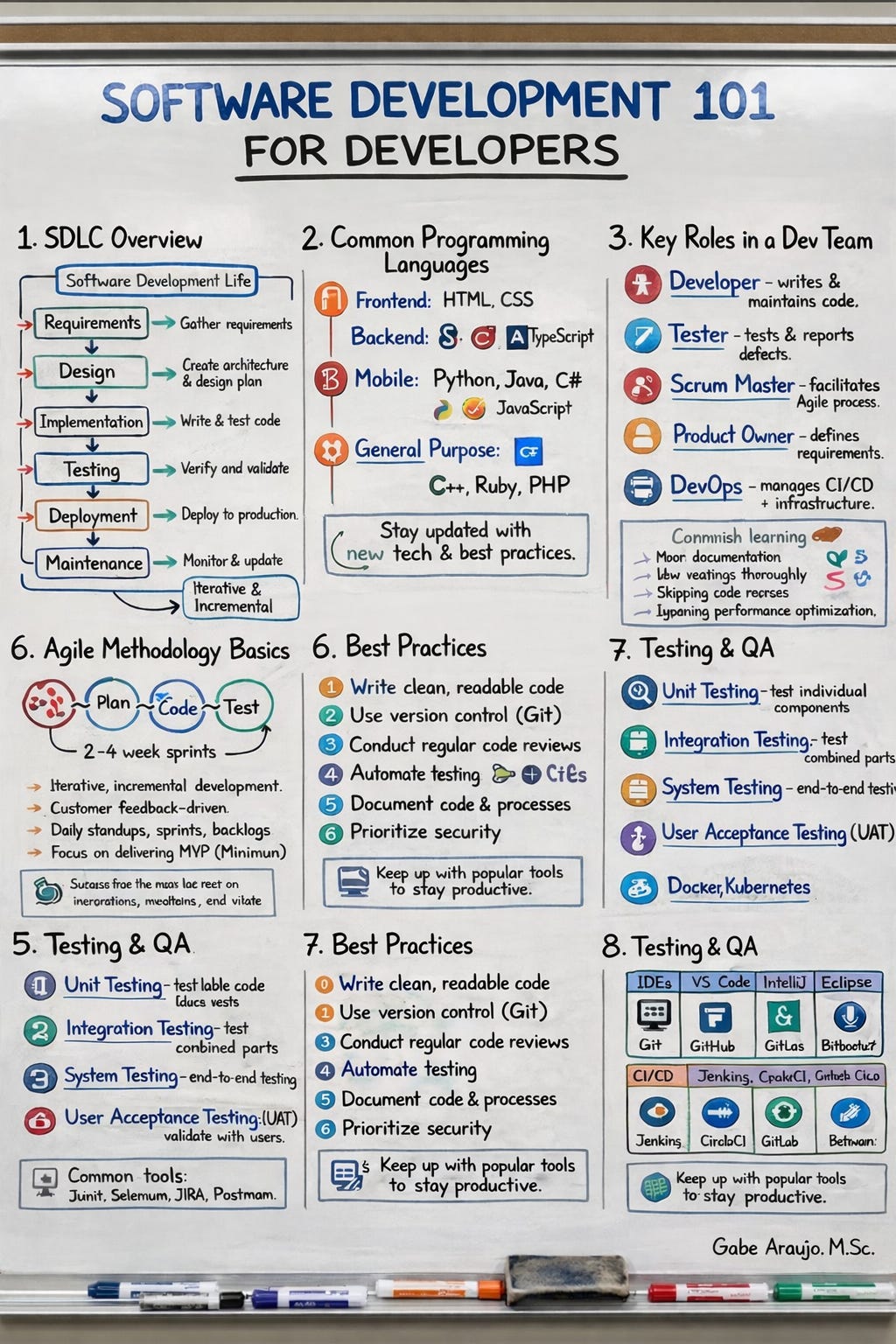
I recently created a whiteboard-style infographic called Software Development 101 to compress the essential structure of modern software engineering into a single visual reference. What follows is the thinking behind it.
Not a tutorial.
Not a trend list.
A systems-level orientation.
Why Fundamentals Still Dominate Outcomes
Despite exponential tooling improvements, the dominant causes of failed software projects remain stubbornly consistent:
Unclear requirements
Poor architectural decisions
Inadequate testing
Broken communication loops
Lack of ownership
None of these are solved by adopting a new framework.
They are solved by process clarity and shared mental models.
Great teams outperform average teams not because they know more syntax, but because they align faster around:
What problem they’re solving
How they’ll build it
How they’ll verify it works
How they’ll evolve it safely
The Software Development Lifecycle (SDLC)
At its core, nearly every successful system follows the same loop:
Requirements
Design
Implementation
Testing
Deployment
Maintenance
This is not a waterfall mandate.
It’s a logical dependency chain.
You cannot test what you haven’t implemented.
You cannot implement what you haven’t designed.
You cannot design what you don’t understand.
Modern teams execute this loop iteratively and incrementally, but they never escape it.
Ignoring a stage doesn’t remove it.
It only pushes its cost downstream.
Languages Are Secondary; Problem Domains Are Primary
Developers often ask:
“Which language should I learn?”
A better question:
“Which problem domain am I targeting?”
Frontend → HTML, CSS, JavaScript, TypeScript
Backend → Python, Java, C#, Node.js
Mobile → Swift, Kotlin, Flutter, React Native
Systems / Performance → C++, Rust, Go
Languages are tools.
Architecture, data modeling, and reasoning ability produce leverage.
Roles Exist to Reduce Cognitive Load
High-performing teams distribute responsibility intentionally:
Developer → Builds and maintains code
Tester / QA → Validates correctness
Product Owner → Defines value
Scrum Master / Delivery Lead → Removes friction
DevOps / Platform → Enables reliable delivery
These are not titles for status.
They are functions.
When one function disappears, its work still exists — it simply becomes invisible and usually underperformed.
Agile Is a Feedback Engine, Not a Ceremony
Agile succeeds when treated as:
Short cycle → Build → Test → Learn → Adjust
Not:
Meeting → Meeting → Meeting
Core mechanics:
Small batches
Frequent integration
Continuous feedback
Ruthless prioritization
Agile is not about speed.
It’s about error detection velocity.
Testing Is Risk Management
Testing is often framed as quality.
More accurately, testing is risk control.
Unit Tests → Local correctness
Integration Tests → Component interactions
System Tests → End-to-end behavior
UAT → Business validation
Each layer catches a different class of failure.
Skipping layers doesn’t save time.
It creates delayed explosions.
Best Practices Are Boring Because They Work
Every mature team converges on the same habits:
Clean, readable code
Version control
Code reviews
Automated tests
Documentation
Security-first thinking
None of this is exciting.
All of it compounds.
Engineering excellence is less about brilliance and more about consistency.
Tooling Should Serve Flow, Not Ego
IDEs.
Git.
CI/CD.
Containers.
Cloud platforms.
Tools exist to reduce friction between:
Idea → Code → Verified Change → Production
If a tool doesn’t shorten that path or reduce failure probability, it’s noise.
The Hidden Skill: Systems Thinking
Senior engineers differ from juniors in one primary way:
They think in systems, not tasks.
They ask:
Where does this change ripple?
What assumptions does this encode?
What breaks if this fails?
How will this be maintained in two years?
The infographic is ultimately a prompt toward this mindset.
Final Thought
Software development is not magic.
It is applied logic, executed through disciplined feedback loops, inside socio-technical systems.
Master the loop.
Respect the fundamentals.
Let tools come and go.
If you’d like a high-resolution copy of the Software Development 101 infographic, reply or subscribe — I’ll share it in the next post.
Solid breakdown of what actually seperates high-performing teams. The insight about stages never disappearing, just shifting downstream as invisible costs, really lands. I've seen this play out in prod systems where we skipped integration testing for deadlines and ended up firefighting interaction bugs that cost 3x more time later. Process clarity compounds way harder than framework choice.