Software Engineering Is Dead. English Will Be a Coding Language.
Applied Code — Premium Edition

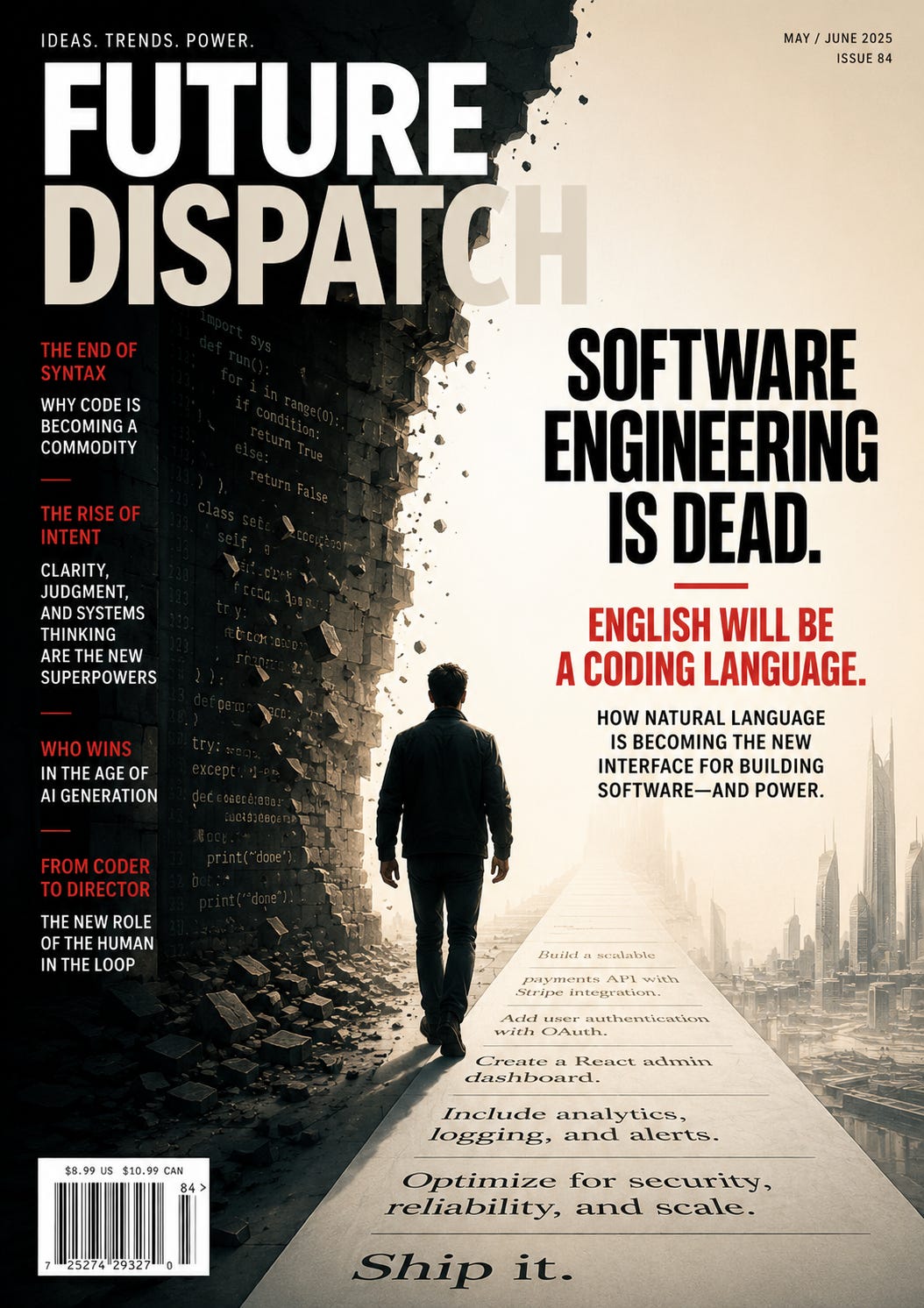
For seventy years, software engineering was fundamentally about one thing:
translating human intent into machine-readable syntax.
That era is ending.
The next generation of software will not primarily be written in Python, JavaScript, Rust, or C++.
It will be written in structured English — or whatever natural language humans use to express goals, constraints, incentives, and operational intent.
The programmer is evolving from code mechanic into cognitive systems director.
Most institutions still underestimate the scale of this transition.
They believe AI is merely accelerating software development.
In reality, AI is reorganizing the economic architecture of cognition itself.
Signals Already Visible
The transition is no longer theoretical.
Several measurable indicators already point toward a restructuring of software creation:
GitHub productivity studies found developers completed certain programming tasks up to 55% faster using AI-assisted tooling. GitHub Copilot productivity analysis
Enterprise productivity gains from AI coding systems increasingly cluster between 20–40% depending on workflow maturity and organizational integration. Enterprise AI coding productivity research
Simultaneously, organizations report rising burdens around verification, review overhead, technical debt, and maintenance of AI-generated systems. Research on AI-generated code review overhead
The critical point is not that AI writes code.
It is that implementation itself is becoming increasingly compressible.
The Historical Direction of Computing Was Always Abstraction
Programming languages were never the destination.
They were temporary translation layers between human intention and machine execution.
Every major era of computing reduced the amount of mechanical precision humans needed to provide:
Assembly abstracted raw hardware operations.
C abstracted memory orchestration.
Python abstracted systems complexity.
Frameworks abstracted infrastructure.
Cloud platforms abstracted deployment.
AI now abstracts implementation itself.
The long arc of computing moves consistently toward three things:
less syntax,
more semantic intent,
broader accessibility.
COBOL replaced machine code.
Python replaced much of C.
Natural language now replaces increasing portions of Python.
The trajectory only appears shocking because humans mistake temporary interfaces for permanent systems.
Programming languages were never sacred.
They were scaffolding.
AI Is Not Replacing Programming. It Is Industrializing Abstraction.
Most commentary frames AI as a labor substitution technology:
machines replacing coders.
That framing is incomplete.
What is actually occurring is the industrialization of abstraction itself.
Large language models are probabilistic intent-compilers.
They map ambiguous human objectives into executable structures.
A modern workflow increasingly resembles this:
“Build a payments platform with Stripe integration, enterprise-grade authentication, SOC2 logging, EU regulatory compliance, multi-tenant architecture, and a procurement-optimized React admin layer.”
That single paragraph can now replace:
weeks of scaffolding,
dependency management,
API wiring,
documentation lookup,
boilerplate generation,
testing setup,
and large amounts of junior engineering labor.
The bottleneck shifts from:
implementation
to:
specification.
Recent empirical studies already suggest this transition is measurable.
A 2026 meta-analysis covering 23 studies found statistically significant productivity gains from AI-assisted programming, though with substantial variation depending on task complexity and organizational context. Meta-analysis of AI coding productivity research (2026)
A separate longitudinal analysis documented benchmark performance on SWE-bench Verified rising from 1.96% to 78.4% between late 2023 and early 2026. Agentic AI and the restructuring of software engineering
This changes the nature of economic value creation in software.
The scarce resource is no longer syntax production.
The scarce resource becomes:
judgment,
decomposition,
systems thinking,
strategic clarity,
and precision of intent.
Rhetoric becomes infrastructure.
The Cognitive Supply Chain Is Being Rewritten
The most important shift is not technical.
It is organizational.
For decades, software engineering operated like a manufacturing pipeline:
executives define goals,
product managers translate requirements,
architects design systems,
engineers implement logic,
QA verifies outputs,
operations deploy infrastructure.
AI collapses enormous portions of this chain.
The future software stack increasingly resembles four layers:
The Four Layers of Cognitive Infrastructure
1. Intent
Defining objectives, constraints, incentives, and acceptable tradeoffs.
This becomes the highest-leverage layer.
2. Orchestration
Coordinating humans, agents, models, APIs, workflows, and verification systems.
The future engineer increasingly resembles a conductor of distributed cognition.
3. Execution
Actual implementation.
This layer rapidly commoditizes.
Inside frontier AI firms, this shift is already operational rather than theoretical.
Executives at Anthropic stated in 2026 that AI systems now generate the overwhelming majority of internal code, shifting human roles toward supervision, architecture, and strategic oversight. Anthropic says AI now writes most of its code
4. Verification
Ensuring correctness, security, legality, reliability, and strategic alignment.
Ironically, as generation becomes cheap, verification becomes extraordinarily valuable.
This is where trust migrates.
The Real Casualties Are Not Elite Engineers
The first wave of disruption does not primarily eliminate exceptional technical talent.
It eliminates standardized implementation labor.
That includes:
CRUD developers,
template-stack freelancers,
boilerplate maintainers,
outsourced implementation teams,
low-level integration work,
and large portions of junior engineering pipelines.
This is economically uncomfortable because modern software ecosystems became optimized around modular repetition.
An enormous percentage of global software work consists of:
moving JSON between APIs,
configuring frameworks,
stitching together abstractions,
debugging dependency conflicts,
and replicating known architectural patterns.
LLMs are unusually effective at pattern-compressible cognition.
The industry spent decades standardizing engineering into interchangeable component assembly.
Now machines can assemble the components.
The Collapse of the Apprenticeship Economy
One under-discussed consequence is the destruction of white-collar apprenticeship systems.
Junior engineers historically learned through repetitive implementation work.
But if AI absorbs:
debugging,
scaffolding,
integration,
documentation parsing,
and routine architecture,
then organizations lose the training ground that historically produced senior talent.
This creates a paradox:
AI increases short-term productivity while potentially weakening long-term expertise formation.
The same phenomenon may hit:
law,
consulting,
finance,
analytics,
marketing,
and operations.
Many elite professions depend on gradual cognitive accumulation through low-level execution.
AI threatens to compress the bottom layers before new educational structures exist to replace them.
Large enterprises are already restructuring engineering expectations around this reality.
Ernst & Young reported in 2026 that software engineering, AI engineering, and data engineering roles are rapidly converging into orchestration-oriented product functions rather than implementation-specialist roles. EY on the convergence of engineering roles under AI
That may become one of the defining labor crises of the next decade.
English Is Becoming an Operating System
Natural language is evolving into executable infrastructure.
This is historically extraordinary.
For centuries, literacy represented social leverage.
Then programming became a secondary literacy layer for technological civilization.
Now programming itself is being absorbed back into language.
But there is an asymmetry hidden underneath this transition:
AI models are disproportionately trained on English-language corpora.
That means the rise of natural-language computing may reinforce Anglo-American dominance across:
software,
finance,
governance,
legal infrastructure,
and institutional coordination.
English increasingly functions not merely as communication —
but as the command layer of global computation.
This may become the greatest soft-power amplifier for the United States since the internet itself.
The implications are geopolitical, not merely technical.
The Global Labor Shock Has Barely Started
The economic implications are profound.
Software development has been one of the largest global pathways into the middle class.
Entire economies partially organized themselves around outsourced implementation labor.
Countries heavily exposed include:
India,
the Philippines,
Eastern Europe,
and parts of Latin America.
But AI disproportionately compresses modular cognitive labor.
Which means the first casualties are often nations integrated into global implementation pipelines rather than strategic control layers.
This creates a new hierarchy:
LayerEconomic ValueCompute ownershipExtremely highModel ownershipExtremely highDistribution platformsHighOrchestration systemsHighVerification/trustIncreasingCommodity implementationRapidly declining
The global software economy may bifurcate between:
cognitive infrastructure owners,
and cognitively commoditized labor pools.
The SaaS Model Itself May Be Temporary
Most investors still assume software remains a persistent product category.
That assumption may fail.
If AI can dynamically regenerate applications on demand, many traditional software structures weaken dramatically.
Future software may become:
adaptive,
temporary,
continuously rewritten,
context-specific,
and agentically assembled.
The implication is radical:
Software transitions from static product
to living process.
This threatens the economic defensibility of many SaaS companies.
Historically, software valuation depended on:
maintenance difficulty,
switching costs,
workflow lock-in,
and technical complexity.
But if systems become infinitely malleable, defensibility migrates elsewhere:
trust,
distribution,
proprietary data,
regulatory permission,
ecosystem control,
and compute access.
The code itself becomes less valuable than the institutional position surrounding it.
The New Elite Engineer
The future elite technologist resembles less a programmer and more:
strategist,
economist,
organizational architect,
security theorist,
systems philosopher,
and operator of machine cognition.
Because once implementation becomes abundant, the scarce resource becomes:
judgment,
prioritization,
reliability,
accountability,
and strategic coherence.
AI can generate code.
But it still struggles with:
adversarial reasoning,
ambiguous institutional tradeoffs,
legal liability,
distributed political consequences,
long-horizon architecture governance,
and deep organizational context.
The hard part of software was never typing.
The hard part was deciding:
what should exist,
why it should exist,
and what happens when it fails.
The Productivity-Reliability Paradox
The evidence around AI productivity remains more complex than public discourse suggests.
While controlled studies often show substantial gains in isolated coding tasks, enterprise environments frequently experience downstream quality and governance costs.
A 2026 governance paper termed this the “Productivity-Reliability Paradox,” arguing that specification discipline — rather than raw model capability — is increasingly the limiting factor in AI-augmented engineering systems. The Productivity-Reliability Paradox paper (2026)
Meanwhile, enterprise telemetry studies show that AI-assisted workflows can increase pull-request volume while simultaneously increasing review times, remediation work, and organizational coordination burdens. Enterprise study on AI-generated review overhead
This matters because implementation may commoditize faster than trust.
Verification becomes the premium layer.
The Coming Era of Disposable Organizations
The deeper implication is not merely that software changes.
Organizations themselves may change.
Historically, institutions existed partly because coordination costs were high.
AI radically lowers coordination friction.
A single highly capable operator can now leverage:
AI agents,
automated infrastructure,
synthetic research,
dynamic software generation,
and machine-augmented execution.
This creates extreme asymmetry.
The rise of “one-person firms” may become one of the defining economic phenomena of the 2030s.
Not because individuals become smarter —
but because organizational overhead collapses.
The modern corporation may partially evolve from:
labor aggregation machine
into:
coordination and trust infrastructure.
What Executives Should Do Now
Most enterprises remain structurally unprepared.
The strategic response is not:
“adopt AI tools.”
It is:
reorganize around cognitive leverage.
Major consulting firms increasingly view AI not as a tooling upgrade but as an organizational redesign problem.
McKinsey & Company argues that realizing AI’s value in software development requires “a complete overhaul of processes, roles, and ways of working.” McKinsey on unlocking the value of AI in software development
Enterprises
Should:
reduce implementation-heavy org structures,
prioritize orchestration capability,
build verification systems,
and redesign workflows around agentic execution.
Governments
Should:
invest aggressively in compute sovereignty,
protect domestic AI infrastructure,
rethink education systems,
and prepare for white-collar labor compression.
Individuals
Should move from:
syntax memorization,
and implementation labor
toward:
systems thinking,
persuasion,
strategic synthesis,
institutional literacy,
and decision-making under uncertainty.
The future belongs less to coders
than to cognitive directors.
Forecasts
Over the next decade, several shifts appear increasingly probable:
More than half of routine enterprise software implementation work becomes AI-assisted or AI-executed.
Software engineering headcount growth slows even as software output explodes.
Verification, security, governance, and orchestration become the highest-compensated layers of technical organizations.
English-language AI ecosystems strengthen U.S. institutional and economic leverage globally.
The distinction between “manager,” “operator,” and “engineer” begins to collapse.
Confidence levels vary across timelines and sectors, but the directional trend toward cognitive compression appears increasingly robust. Agentic AI and the restructuring of software engineering
The Final Irony
For most of history, literacy was power.
Then programming became the new literacy.
Now programming itself is being absorbed by language.
Civilization may be returning to something ancient:
the people who shape the future are not necessarily the best technicians.
They are the people most capable of articulating reality clearly enough that increasingly powerful systems move in response.
The next great programmers may not look like engineers at all.
They may look like:
philosophers,
economists,
generals,
storytellers,
institutional strategists,
and poets operating machine cognition at planetary scale.