The Default That Matters: How Small Decisions Quietly Determine Whether Code Survives

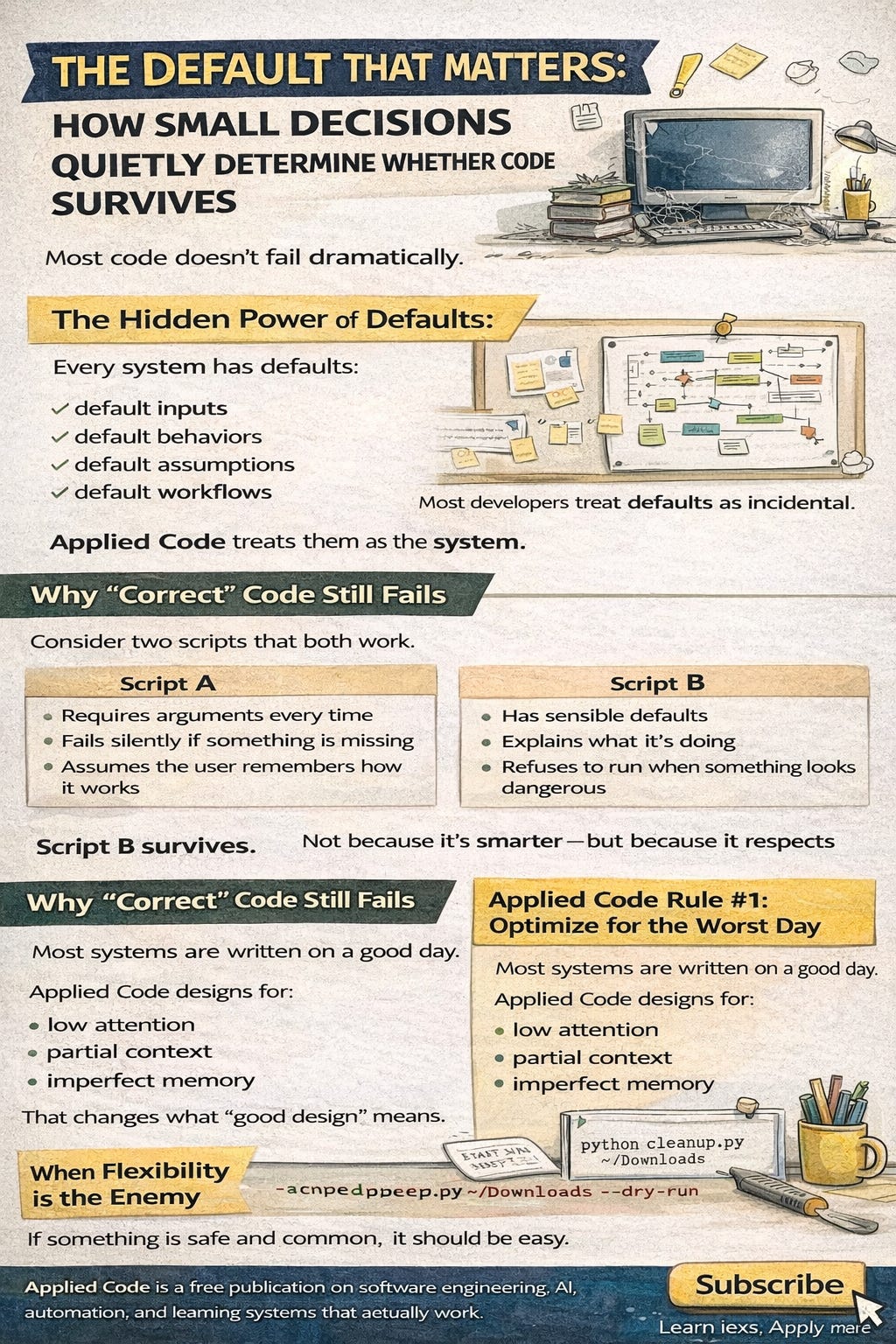
Most code doesn’t fail dramatically.
It doesn’t crash.
It doesn’t throw errors.
It doesn’t even break.
It just… stops being used.
Someone avoids touching it.
Someone rewrites it instead of extending it.
Someone works around it rather than with it.
When that happens, the problem usually isn’t complexity.
It’s defaults.
The Hidden Power of Defaults
Every system has defaults:
default inputs
default behaviors
default assumptions
default workflows
Most developers treat defaults as incidental.
Applied Code treats them as the system.
Why?
Because defaults determine what happens when:
you’re tired
you’re in a hurry
you don’t remember how something works
you haven’t touched the code in months
That’s when real behavior reveals itself.
Why “Correct” Code Still Fails
Consider two scripts that both work.
Script A
Requires arguments every time
Fails silently if something is missing
Assumes the user remembers how it works
Script B
Has sensible defaults
Explains what it’s doing
Refuses to run when something looks dangerous
Script B survives.
Not because it’s smarter—but because it respects reality.
Applied Code Rule #1: Optimize for the Worst Day
Most systems are written on a good day.
Applied Code designs for:
low attention
partial context
imperfect memory
That changes what “good design” means.
Instead of asking:
“Is this flexible?”
Ask:
“What happens when I run this half-awake?”
Example: A Default That Saves You
Imagine a script that deletes files.
A common (bad) default:
python cleanup.py ~/Downloads
An Applied Code default:
python cleanup.py ~/Downloads --dry-run
Why?
Because destructive actions should require intent, not habit.
That one choice:
prevents irreversible mistakes
makes the tool safer to reuse
increases trust
Trust is what keeps code alive.
Applied Code Rule #2: Defaults Should Bias Toward Safety
Defaults are not neutral.
They either:
protect you
or punish you
Applied Code biases toward:
dry-runs
read-only behavior
explicit confirmation
visible output
If something can cause damage, it should feel slightly inconvenient to do so.
When Flexibility Is the Enemy
Many systems fail because they’re too configurable.
Flags everywhere.
Options no one remembers.
Behavior that changes based on hidden state.
Applied Code prefers:
fewer knobs
obvious behavior
repetition over cleverness
A boring default beats a flexible one you don’t trust.
Applied Code Rule #3: Make the Common Case Effortless
If something is safe and common, it should be easy.
If something is rare or risky, it should be explicit.
That’s it.
This applies to:
scripts
APIs
workflows
even learning systems
When the defaults align with reality, systems feel intuitive without explanation.
Why This Matters More Than Style
You can refactor ugly code.
You can optimize slow code.
But code with bad defaults:
creates anxiety
increases hesitation
encourages avoidance
That’s how systems rot—not through failure, but through neglect.
Applied Code in Practice
Before you keep or share any piece of code, ask:
What happens if I forget how this works?
What happens if I run this twice?
What happens if the inputs are wrong?
What happens if I’m rushed?
If the answers make you uncomfortable, the defaults need work.
The Applied Code Mindset
Applied Code isn’t about perfection.
It’s about reducing friction between:
intention
execution
reuse
Defaults are where that friction lives.
Fix them, and everything downstream improves.
Try This Today
Open one script you’ve written.
Change one default:
add
--dry-runmake output clearer
fail earlier
remove an unnecessary option
Then run it tomorrow without thinking.
If it still behaves the way you expect—that’s Applied Code working.
Applied Code is a free publication on software engineering, AI, automation, and learning systems that actually work. Learn less. Apply more.